AWS EDP & PPA Guide (2026): Discounts, Marketplace Rules, and Negotiation

August 21, 2026
AWS Pricing & Cost Optimization
What is the AWS Enterprise Discount Program (EDP)?
The AWS Enterprise Discount Program (EDP) is what AWS now calls a Private Pricing Agreement (PPA). Your account manager may use either name; it’s the same thing. In exchange for committing to a set amount of AWS spend over one to five years, you get a percentage off nearly every AWS service, in every region, for the life of the contract.
We wrote the first version of this guide a few years ago. Since then, AWS tightened the rules on which Marketplace purchases count toward your commit, AI workloads became the least predictable line on most bills, and a lot of companies that signed EDPs in 2023 and 2024 are now heading into renewals with a commit that no longer matches how they use AWS. So we’ve updated this post for 2026.
Below, we’ll cover how the EDP / PPA works, who qualifies and what discounts to expect, what changed in 2026, what happens if you over- or under-commit, and how to prepare your finance and engineering teams for the negotiation.
Prepping for a negotiation? Get a free EDP financial report of your historical AWS cost.
Is a Private Pricing Agreement (PPA) the same as an EDP?
The AWS Private Pricing Agreement (PPA) and AWS Enterprise Discount Program (EDP) are identical, with no significant differences. AWS account managers often interchange these programs in discussions with eligible users for a committed spending discount.
This interchangeable use stems from the fact that both programs are designed to provide discount benefits to customers who agree to a certain level of spending over a specified period. Whether referred to as a PPA or EDP, the core idea remains: offering a pricing advantage to clients who make a substantial, long-term commitment to using AWS services.
How the discount works: tiers, terms, and what’s covered
Cloud vendor pricing tiers are challenging to decipher, and the discount options are unclear. The AWS PPA / EDP program, however, offers a systematic approach to encourage long-term partnerships that reward predictable and high-volume AWS consumption. If your AWS bill exceeds $100k USD monthly (and less for some non-US regions), the AWS PPA / EDP might be a viable option.
AWS PPA / EDP is a tailored discount agreement offered to AWS customers demonstrating a history of high spending commitment with the cloud vendor. The program incentivizes long-term partnerships with discounts on future spending commitments.
AWS customers who qualify for the PPA / EDP program have typically spent $1+ million annually on AWS services and project at least similar spending commitments over the coming years. The discount offer varies based on several factors, but advisory firms that see these contracts report discounts in the mid-single digits at a $1M commit, rising toward 20%+ at $50M and up, with longer terms earning a few points more. AWS publishes none of this, so treat any number as a starting point.
The discount typically scales as you commit to a higher spending amount and longer-term length. AWS PPA / EDP offers a steep increase in discount percentage starting from annual commitments of $1+M, reaching its highest discount bracket for annual commitments of $50M or more.
It’s important to note that any overconsumption of services beyond the PPA / EDP committed spending is charged at the prevailing PPA / EDP rate and the extra spending doesn’t count toward retiring future term EDP commitments.
Similarly, underconsumption of the committed spending doesn’t reduce the amount owed under the PPA / EDP program, or rollover credits to the next commitment term. The PPA / EDP AWS discount program generally covers most AWS solutions across all AWS regions.
With respect to these terms, the AWS PPA / EDP Program is most suitable for organizations that are confident in their future service consumption and spend requirements, with minimal chance of significant reductions in AWS cost.
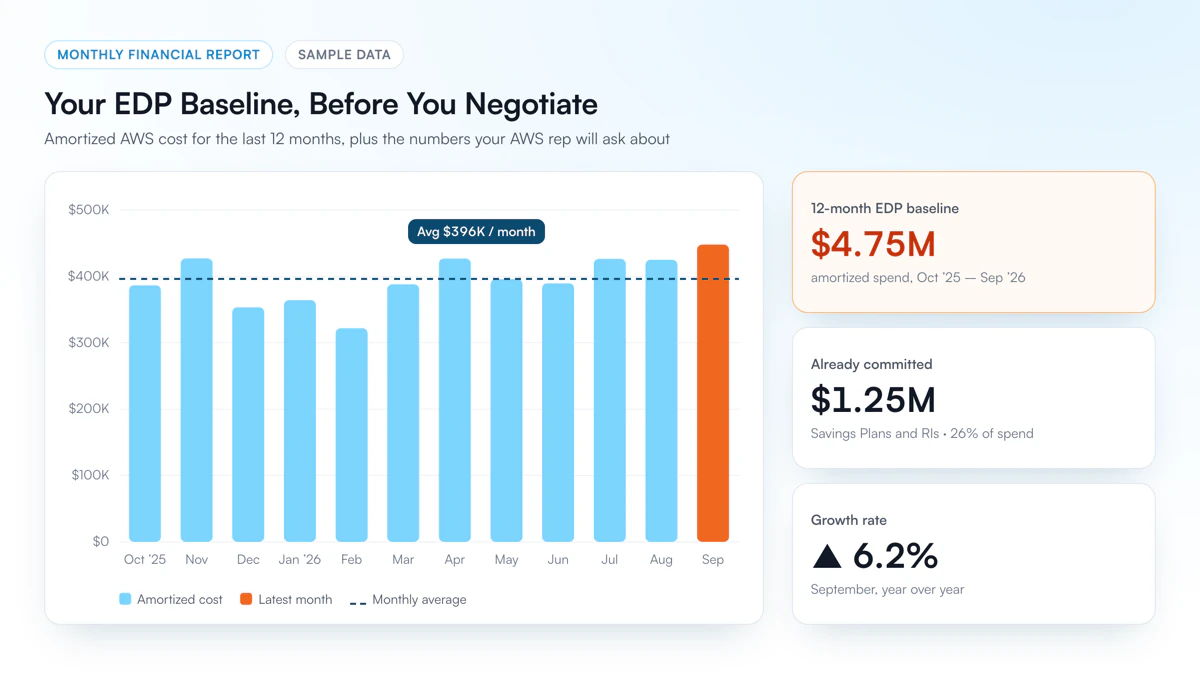
Before you pick a commit level, you need your real baseline. You can get it in a free EDP financial report from CloudForecast: monthly amortized AWS cost by service and account, plus your Reserved Instance and Savings Plan purchases.
Who qualifies, and what else is in the contract
- Annual Spending Commitment: Starts at $1+ million for US-based orgs.
- Term length: Usually a 1 to 5 year term is standard.
Customers who commit more, and for longer, will move up in discount tiers. Standard tiering starts at around $1m and gradually increases with commitments. Although a precise discount rate is often not publicly shared, deals such as $300m by Lyft would have enjoyed a significant discount
In terms of contract duration, AWS favors long-term commitments. A single 3-year term may be more viable than three 1-year terms for the same purchase commitment for PPA / EDP Customers in two ways.
First, the longer-term duration qualifies for a higher PPA / EDP discount bracket. Secondly, the limitations associated with underspending/overspending PPA / EDP AWS commitments only apply with respect to the full term duration.
Consider a simple case example:


While the value of services consumed over three years is the same in both cases, the shorter 1-year PPA / EDP AWS term of Case A causes the customer to pay the difference for the underspent amount, and purchase additional services for overspent consumption based on the expensive on-demand pricing model.
Other variables that may affect your AWS PPA / EDP contract include:
- Prepayment: While prepayment is no longer required, AWS may offer additional discounts for partial or full prepayment
- AWS Marketplace: Eligible AWS Marketplace purchases retire your commit at full value, capped at 25% of the annual commitment, but they are billed at the vendor’s price, not your EDP rate. See the 2026 section for what ‘eligible’ now means.
- Projected Future Spending: Do you have the ability to migrate existing on-premise services to AWS (or another cloud)? This can potentially give you better negotiation power for future contracts.
- Support Pricing and Services: AWS requires PPA / EDP customers to enroll in the AWS Enterprise Support program for the duration of the PPA / EDP contract. There may be an opportunity to clarify and negotiate what AWS support is provided throughout the PPA / EDP contract period.
- Non-decreasing commit: AWS expects each year’s commitment to be equal to or higher than the year before. Flat is fine; shrinking is a negotiation.
What changed in 2026: Marketplace rules, AI spend, and commitment wind-down
If you signed an EDP before 2025, three things have shifted under you. None of them changes the basic deal, but all three change how much commit you should sign for and what you should ask for in the contract.
AWS Marketplace purchases: only “Deployed on AWS” software counts now
Marketplace has always been the easiest way to make your commit number. Buy the SaaS tools your engineering team already pays for through AWS Marketplace private offers, and that spend retires your commit, up to 25% of the annual commitment.
The rules for what counts have tightened over time. Before 2022, only 50% of Marketplace spend counted. From 2022 through April 2025, 100% of eligible SaaS purchases counted, under the 25% cap. Since May 1, 2025, a SaaS product only counts if it runs entirely on AWS. AWS marks these with a “Deployed on AWS” badge in Marketplace, and the Marketplace Single Pane of Glass dashboard (updated October 2025) now shows you the badge status of everything you subscribe to.
Two practical consequences:
- Audit your Marketplace spend before you size the commit. A vendor that hosts part of its stack on another cloud no longer helps you. AWS notified sellers about this change, not customers, so don’t assume your current tools still qualify. Pull the list from the dashboard and check badges.
- Marketplace retires commit at full value but gets no discount. A $1M Marketplace purchase burns $1M of commit, and you pay the vendor’s price. That is still worth doing for software you’d buy anyway, but it’s not “free” savings, and it shouldn’t be counted twice in your model.
One newer wrinkle: AWS added an “AI Agents and Tools” category to Marketplace in mid-2025. Agent and model products bought there through private offers follow the same rules, so if your teams are buying AI tooling, route it through Marketplace where the vendor carries the badge.
AI usage is the hardest line to forecast, so don’t commit to it blindly
Most EDP forecasts we see from customers are built on EC2, S3, RDS, and data transfer, which are predictable. The line that breaks the forecast in 2026 is AI: Bedrock inference, GPU instances and Capacity Blocks, Trainium, and the storage and data movement that comes with them.
This spend is volatile in both directions. Pilots get cancelled. A product that works goes from $5k a month to $500k a month in a quarter. Prices move too: AWS raised EC2 Capacity Block pricing for GPU and Trainium instances by roughly 15% in April 2026. A commit that was “safe” with AI spend baked in can become a shortfall when a pilot stops, and a commit sized without it leaves discount on the table when a pilot ships.
What we’d suggest:
- Separate proven AI spend from experimental AI spend in your forecast. Commit to the proven part. Treat the experimental part as upside that would retire commit early, not as the base.
- Ask for a ramp. A back-loaded schedule (lower commit in year one, rising in years two and three) lets AI workloads prove themselves before you’re on the hook for them. Advisory firms report that a ramp is one of the easier asks to get approved.
- Ask about service-specific pricing for Bedrock. AWS is pushing AI adoption and has been willing to layer additional Bedrock pricing on top of a base EDP. It won’t be offered; you have to ask.
- Get attribution in place first. Since April 2026, Bedrock can attribute inference cost to the IAM principal that made the call, which finally makes team-level AI chargeback possible. It doesn’t backfill, so turn it on now if you want clean data for a negotiation next year.
Commitment wind-down: renewals, step-downs, and exits
A lot of EDPs signed in 2023 and 2024 are coming up for renewal with a commit that assumed growth that didn’t happen, or happened somewhere else. Here’s what you need to know going in.
- Shortfalls are invoiced, not forgiven. If you under-consume, AWS bills the difference at the end of the term (or year, depending on how the contract is written). Unused commit doesn’t roll over.
- Early termination means paying the remaining commit. There’s no clean exit mid-term. If you’re considering a partial move off AWS, model the remaining commit as a real cost of that move.
- Step-down clauses exist, but only if you negotiate them up front. Some customers get the right to reduce the annual commit (advisory firms cite 25–40%) under defined conditions like divestiture or a major workload exit. AWS won’t volunteer it at renewal time.
- Enterprise Support goes with the EDP. If you wind the EDP down, your support tier and its cost are part of the conversation.
- A renewal is a new negotiation. Your leverage is your forecast and your alternatives, same as the first time. Come with 12–24 months of amortized cost by service, your Marketplace badge audit, and a clear split of committed vs experimental AI spend. The worst outcome is renewing at the old number because nobody rebuilt the model.
That's what the free EDP financial report gives you: monthly amortized cost by service and account, ready for the renewal conversation. Get the report
What happens if you over-commit or under-commit
If you’re tracking under your commit, you have a year-end bill coming unless you close the gap. Options, roughly in order of how much sense they make: pull forward a migration that was already planned; move software purchases you’re already making onto AWS Marketplace (badge-eligible only); consolidate accounts from a subsidiary or acquired company under the payer account covered by the EDP; expand non-production or DR environments that you’d been deferring. Spending money you wouldn’t otherwise spend to avoid a shortfall fee is only worth it if the spend has value on its own. A shortfall fee is just the discount you didn’t earn; it isn’t a penalty on top.
If you’re tracking well over your commit, the overage is billed at your EDP rate, which is fine, but it doesn’t count toward next year’s commit and you’re not getting the tier you could have. Track it, and bring it to the renewal as evidence for a higher tier or a better rate on the same tier. Don’t sign a larger commit mid-term to chase a tier unless the forecast is solid; that’s how people end up in the first paragraph.
Negotiation checklist for finance and engineering
So how do you prepare for AWS PPA / EDP contract negotiations if you already qualify for the PPA / EDP program? Take the following considerations into account as you negotiate your way to a profitable partnership with AWS:
So how do you prepare for AWS PPA / EDP contract negotiations if you already qualify for the PPA / EDP program? Take the following considerations into account as you negotiate your way to a profitable partnership with AWS:
- Forecast Growth, Compute, and Usage Demands with Amazon S3, EC2, RDS, and other AWS Services: Your product and engineering growth plans may dramatically affect AWS costs on various services. Working with your finance and engineering teams to forecast accurately projected compute and usage demands over the next few years is essential for cost optimization. Review your past AWS spending and account for the factors and variables that may impact future user demands. These factors can include user and market trends, cost of cloud services, legal and compliance requirements, security concerns, and more.
- Understand Workloads and AWS Costs: Estimate the TCO (total cost of ownership) of AWS services under the PPA / EDP program. How do they compare with your alternatives: multiple vendors? On-prem/hybrid/multi-cloud options?
- AWS Marketplace Apps: Review the apps your engineering team uses and check in the AWS Marketplace. As mentioned, spending on AWS Marketplace apps can contribute to your committed expenditure.
- Maximize Leverage: Demonstrate the value your business will bring to AWS in terms of a long-term purchase commitment. Accurately forecast your AWS cloud needs and use this information when negotiating a specific PPA / EDP discount tier. Look at the alternatives: Can you find better offers from a competing vendor?
- Hitting the Thresholds: Optimize your PPA / EDP targets to avoid additional costs that may be incurred due to underspending or overspending on your PPA / EDP commitment. Set your commitment thresholds just below your forecasted usage demands to ensure that you don’t leave money on the table due to the underconsumption of the services.
- Understand the Markets: Understand where the markets and your usage trends are headed. How do external factors affect your network traffic and usage demand spikes? What’s the ROI on your business plan to scale AWS PPA / EDP commitments?
- Consolidate spending: Check if others in your immediate organization, parent organization, or subsidiary also consume AWS cloud. By consolidating this spend, you may achieve higher discount tiers.
- Communicate your broader business requirements: PPA / EDPs can help you achieve broader business outcomes than just cost savings. Let your account or partner manager know what your business is trying to do with regards to go-to-market, training and skills, product strategy, and see how they may be able to help.
Getting the correct answers to these questions and preparing yourself for negotiating on the AWS PPA / EDP is crucial to reducing your AWS bill. Strategically approaching the contract discussion improves your negotiation power and will help close a deal tailored for your cloud usage demands at a lower TCO.
How CloudForecast helps you prep the numbers
Trying to build the reports and aggregate all the numbers from the billing dashboard to start forecasting your cost for PPA / EDP negotiations can be tedious and time consuming.
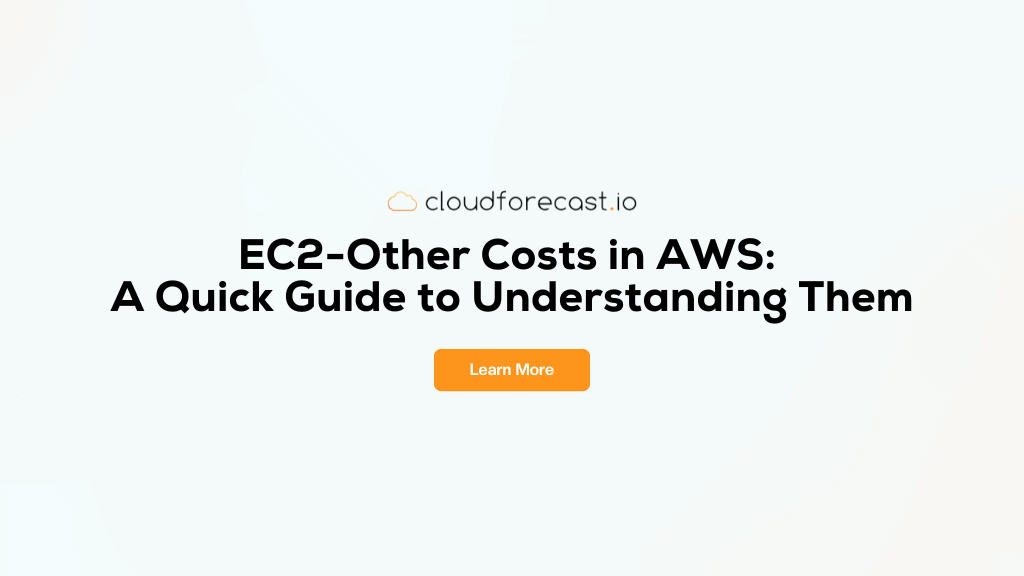
CloudForecast users leverage our Monthly AWS Financial Report and Daily AWS Cost Management Report to prepare for PPA / EDP negotiations.
With information such as AWS Marketplace Purchases, Historical Amortized Cost, RI/SP commitments and other data contributing to your overall AWS invoice, you can quickly and accurately forecast and understand baseline AWS costs for your EDP/PPA negotiations.
Frequently asked questions
What is AWS EDP?
AWS EDP (Enterprise Discount Program) is a private, negotiated contract where you commit to a minimum amount of AWS spend, typically $1M+ per year over one to five years, in exchange for a percentage discount on nearly all AWS services. AWS now calls it a Private Pricing Agreement (PPA).
What is the difference between an AWS EDP and a PPA?
Nothing material. PPA is the current name AWS uses; EDP is the older one that most customers and account managers still say. Both refer to the same committed-spend discount agreement.
What is an AWS Enterprise Agreement?
“AWS Enterprise Agreement” is an informal term people use for the EDP / PPA, often borrowed from Microsoft’s Enterprise Agreement. AWS doesn’t sell a product by that name. If someone asks about your AWS Enterprise Agreement, they mean your EDP / PPA contract and its Enterprise Support requirement.
What is EDP drawdown?
Drawdown (or burn-down) is how much of your committed spend you’ve consumed so far in the term. If you committed $3M for the year and your eligible usage plus Marketplace purchases total $2.1M by September, you’ve drawn down 70% and need $900k more to avoid a shortfall. Tracking drawdown monthly is the single most useful EDP habit.
What is “EDP cloud”?
It’s a shorthand for the AWS usage covered by your EDP contract, not a product. When someone says “that’s in our EDP cloud” they mean the accounts and services whose spend counts toward the commit.
Does an EDP stack with Savings Plans and Reserved Instances?
Yes. The EDP percentage applies on top of whatever Savings Plans, Reserved Instances, and Spot usage you already have, and the discounted spend still counts toward your commit. Get your Savings Plan and RI coverage right first, then size the commit on the lower number. If you came to AWS through the Migration Acceleration Program (MAP), the EDP is usually the next step once migration credits run out.
Tony Chan
Tony is a co-founder of CloudForecast and runs all the business operations: customer success, support, marketing and sales.
Blog
More from CloudForecast


Get a Daily AWS Cost Report Your Team Will Actually Read
What changed and who owns it, in Slack, Teams or email. Read-only access. Every feature is free for 30 days with no credit card, and daily reports stay free after that.
Start Free Trial